In the past few years, I’ve had the opportunity to design and teach my own units, rather than follow a set curriculum or textbook. At the same time, I’ve been creating resources for my TPT store. Both of these experiences have pushed me to think more carefully about how units should be built.
Over time, I’ve come to see unit design not as a way to organize content or hit learning standards, but as a way to engineer the conditions where learning actually happens. Content matters, of course, but the way the students engage with the content is equally important.
Education has changed, especially over the last few years with the introduction of AI. Students can now complete tasks without even engaging with the content, skipping the effort and struggle which leads to real learning. Because of this, the design and structure of a unit and its individual lessons becomes critical.
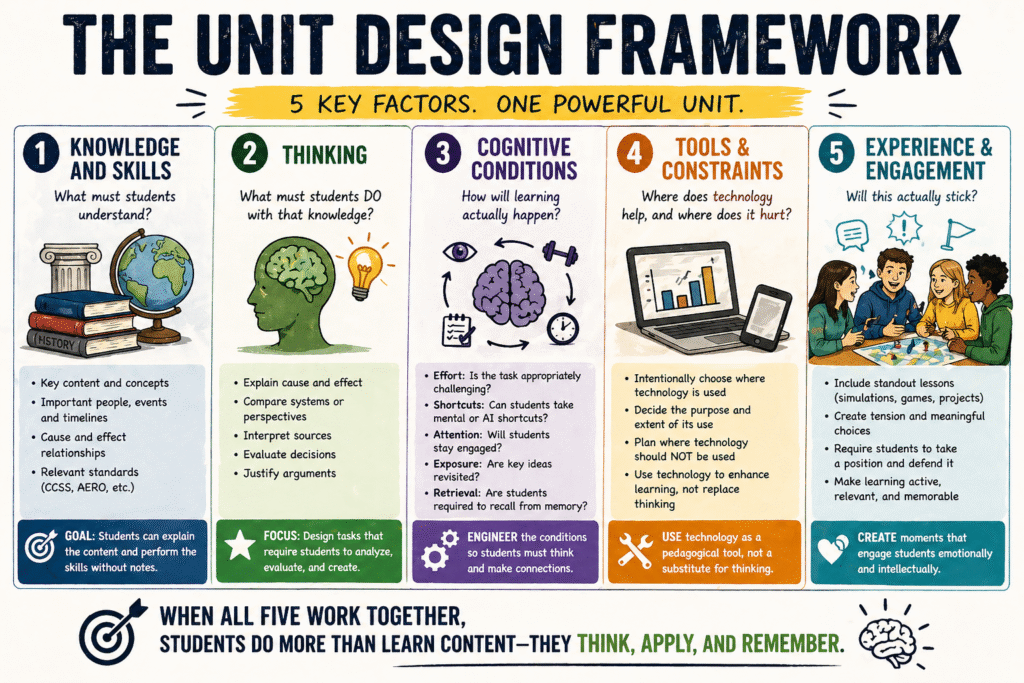
With this in mind, my unit design process over the last few years has led me to develop a Unit Design Framework that helps me balance five key factors when planning a new unit from the start.
1. Knowledge and Skills: What Must Students Understand?
Designing a good learning unit starts with clearly identifying what the students actually need to know. This includes things like:
- Key events and timelines
- Important people and perspectives
- Cause and effect relationships
- Relevant standards (Common Core, AERO, etc.)
The goal here is simple: by the end of the unit, students should be able to explain the content and perform the skills without notes.
This thought process creates the spine of the unit, and ensures that all lessons work toward a common goal.
2. Thinking: What Must Students DO With That Knowledge?
Once the content is clear, the next question is what should students actually do with that knowledge.
This is where I focus on thinking skills (Bloom’s Taxonomy). For example:
- Explaining cause and effect
- Comparing systems or perspectives
- Interpreting sources
- Evaluating decisions
- Justifying arguments
The key here is task design.
For example, instead of asking students to list the causes of a major historical event, I might rather ask them to rank the causes and defend their choices. This small shift creates tension because students have to make a choice, prioritize evidence, and defend their reasoning, rather than simple recall (this also makes the task more AI-resistant, discussed in another post here).
3. Cognitive Conditions: How Will Learning Actually Happen?
This is an important part which I feel is often overlooked, but has a huge impact on whether students actually learn.
A few things I’m always thinking about here are:
- Effort: Is the task too easy or difficult?
- Shortcuts: Can students complete this task without really thinking (think AI)?
- Attention: Will they stay focused?
- Exposure: Are key ideas being revisited across the unit?
- Retrieval: Are students being required to recall information from memory?
One way I try to address this is by focusing on fewer, more demanding tasks (quality over quantity).
When I started teaching history, I used to ask a long series of short questions (Who said this? When did this event happen? What happened after that?) the way I remember learning in school. But I soon realized this leads to surface-level thinking with minimal effort. Students just move from one question to the next without really thinking about or engaging with the content.
So now, instead of asking 5 short recall questions, I might rather ask 1 question that requires students to synthesize those same 5 facts and provide a personal output based on those facts – like ranking, or picking a side, or justifying, and so on.
This is where task design does most of the work. By carefully engineering the learning conditions, I can guide how much thinking is actually required from the students.
4. Tools & Constraints: Where Does Technology Help, and Where Does It Hurt?
Technology, especially AI, has changed education forever, whether we like it or not. Instead of ignoring it or banning it, the best approach is to plan for it and use it to your advantage.
While AI can weaken learning when it replaces student thinking, using it correctly and carefully can turn it into a helpful tool which enhances learning. Doing so also achieves the extra goal of teaching our students relevant technology skills which they’ll need in the future, so that’s a bonus!
So now, when I design a unit, I deliberately choose where technology will be used (and to what extent), and where technology should not be used.
The goal is to use technology as a pedagogical tool to improve student learning, without allowing it to replace their thinking!
5. Experience and Engagement: Will this actually stick?
This is my favorite part of unit design, and my favorite part of teaching too. This is where a unit comes to life.
For every unit I design, I try to ensure that it has:
- At least one standout lesson (often an engaging simulation or game) – preferably a few!
- Regular moments where students are required to make personal decisions and defend them.
The key idea here is tension.
Students remember moments where they had to:
- Choose between options
- Defend a position
- Take a risk
- Deal with uncertainty
So for example, instead of passively learning about historical figures, students might engage in a simulation where they take on the perspective of a historical figure and decide what action they would take in a specific situation.
That tension shifts the student from passive learning to active thinking, which makes the content far more engaging and memorable.
How It All Fits Together
When all these factors are working together, the whole unit feels different:
- Students are doing more than copying notes and reciting facts
- Students are completing more difficult tasks through their own independent thinking
- Lessons build towards decisions, not just answers
- Lessons work together to achieve bigger unit goals, rather than separate and individual lesson goals
- Engagement leads to learning, not just being busy
This framework isn’t just about making a unit look good on paper. It’s about making sure the unit actually works in the classroom: students are engaged, the tasks have purpose, and the learning conditions require real thinking.
Using the Framework with AI
Since developing this framework, I’ve uploaded it into my AI assistant (I use ChatGPT) and instructed the AI to use the framework whenever helping me plan units and lessons. As a result, the AI has become a much more effective curriculum design partner. Rather than suggesting generic activities or following already-published unit outlines, it evaluates ideas through the same lenses I use when making curriculum decisions and provides much more useful, goal-oriented suggestions.
I’ve made an AI-ready version of this framework available as a free download below. It contains the same framework described in this article, but rewritten as a set of instructions that can be uploaded into ChatGPT, Claude, Gemini, or other AI assistants. I’ve also included additional guidance to help the AI act as a stronger curriculum design partner during unit and lesson planning.
Click here to download the AI-Ready Unit Design Framework
In my next post, I’ll walk through how I used this framework to design my next unit, The American Revolution, step-by-step, including the key decisions I made along the way.
Happy teaching!
Mr. G
Pingback: How I Used AI and My Unit Design Framework to Build an American Revolution Unit – Mr. G's Teaching Corner
Comments are closed.