One way I like getting students excited about coming to my class is by starting with fun, engaging warm-up activities (that still have learning value). These are quick, competitive, and easy to set up, and over time they’ve become something my students look forward to.
Why I Use Warm-Up Activities
My approach to warm-ups is simple: they should boost energy, break the routine, and get students thinking before we even start the day’s lesson. Here’s why they’re a regular part of my teaching:
- They get students engaged right from the start.
- They give students something to look forward to before coming to class.
- They break the monotony of a long history unit.
- They expand learning into areas we might not cover directly in class.
Warm-ups aren’t just for fun. They’re a way to build relationships, encourage teamwork, and sneak in extra learning without it feeling like extra work.
Scoring and Rewards
Competition keeps things exciting, so I keep a visible scoreboard tracking class or team points each week. Here’s how I usually run it:
- First half of the year: Classes compete against each other each week. Keep track of each class’s points on the scoreboard, and by the end of the week, the class with the highest score wins.
- Second half of the year: Every week I randomly divide each class into two groups (A & B) and run group vs group competitions. I keep track of their scores on the scoreboard, and by the end of the week, the group in each class with the highest score wins.
- Rewards: At the end of the week, the winning class or group gets a round of candy from the candy jar.
Simple, cheap, and very effective, and I know it’s working when students excitedly rush in each lesson and immediately check the scoreboard to see where they stand.
My Top 4 Warm-Up Games
Below are the warm-up games my middle and high school students love the most. Each one is easy to set up, fun to play, and has a solid learning benefit.
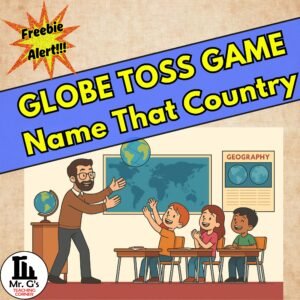
1. Globe Toss
Materials:
- Inflatable globe ball (These are pretty cheap to order online. Tip: Order a few spares – they don’t last forever)
- List of countries for the week (about 25 at a time, from easy to hard)
- Large world map poster, Google Earth, or atlases
Preparation:
Create a few sets of 25 countries per set, with each set getting progressively more difficult, and share these with the students. Be sure to include countries that will come up in your lessons during the year. You can make your own list, or grab my free version on the Free Resources page.
Objective:
Each student gets at least one turn to quickly locate a given country on the globe. Each correct answer gets added to a streak of correct answers. The goal is to get the longest streak of correct answers possible.
How to Play:
- Display this week’s list of countries on the board.
- Give students a few minutes to review their locations.
- To begin, toss the globe to the first student and name a country. Give that student a few seconds to pinpoint that country on the globe (you count down showing your fingers: 5, 4, 3, 2, 1, then, “Time’s up!”)
- If correct, the streak continues to the next student. If wrong, the streak resets with the next student.
- Once all students have had a turn, continue until the streak ends.
Why I Like It:
Students love this game! They often rush to class to squeeze in a few extra minutes learning country locations, and they often coach each other on these locations too. As for me, by the end of the quarter most of them have memorized the locations of about 100 countries, so that’s a total win!
2. Where in the World (WITW)
Materials:
- “Where in the World” Google Slides sets (Free on my Free Resources page)
- Google Earth collections for related sets (included in the above free resource).
Preparation:
Install the “Randomize Slides by Alice Keeler” add-on in Google Slides. Use this to shuffle the order each time for replayability. Share Google Earth links for students to review locations.
Objective:
Each student gets at least one turn to answer the question on the slide. Each correct answer gets added to a streak of correct answers. The goal is to get the longest streak of correct answers possible.
How to Play:
- Give students a few minutes to study the week’s list.
- To begin, Show the first student the question on the first slide. Give that student a few seconds to name the country where that landmark is in (you count down showing your fingers: 5, 4, 3, 2, 1, then, “Time’s up!”).
- If correct, the streak continues to the next student. If wrong, the streak resets with the next student.
- Once all students have had a turn, continue until the streak ends.
Tip: I roam from student to student with my cordless mouse and use that to move between the slides.
Why I Like It:
This game gets students exploring locations on Google Earth, which, for me, is awesome. And because the game requires streak of correct answers, they often coach each other, swapping map tips, and explaining how to find certain places. It’s low-prep, high-energy, and sneaks in a lot of geography.
3. Timeline
Materials:
- Timeline chronology card game. These cost about $20 on Amazon.
- PDFs of each warm-up set in chronological order.
Preparation:
Create 3 sets of cards as follows:
- Set 1: 50 of the easiest cards in the deck, spread across all eras.
- Set 2: All cards from set 1 plus another 25 cards (75 total)
- Set 3: All cards from set 2, plus another 25 cards (100 total)
Create a PDF for set 1, set 2, and set 3, with the events in chronological order for the students to review. Share these with the students (or print).
Objective:
Students need to lay place historical events in the correct location on a timeline to earn points.
How to Play:
- Keep a pen and paper handy to track points for each team on a T-chart
- Split the class into two teams and line these up facing a desk at the front of the room.
- Lay down a starting timeline of three dated events.
- The first player draws a new event (date hidden) and has five seconds to place it in the correct spot on the timeline (you count down showing your fingers: 5, 4, 3, 2, 1, then, “Time’s up!”).
- Correct = point for their team. Incorrect = no point.
- Continue until all players have gone.
Why I Like It:
This builds a sense of historical sequence, often with events we never cover in class. This often gets students coaching each other on historical events, and sometimes leads to them looking up new events they’d never heard of before.
4. General Knowledge Trivia
Materials:
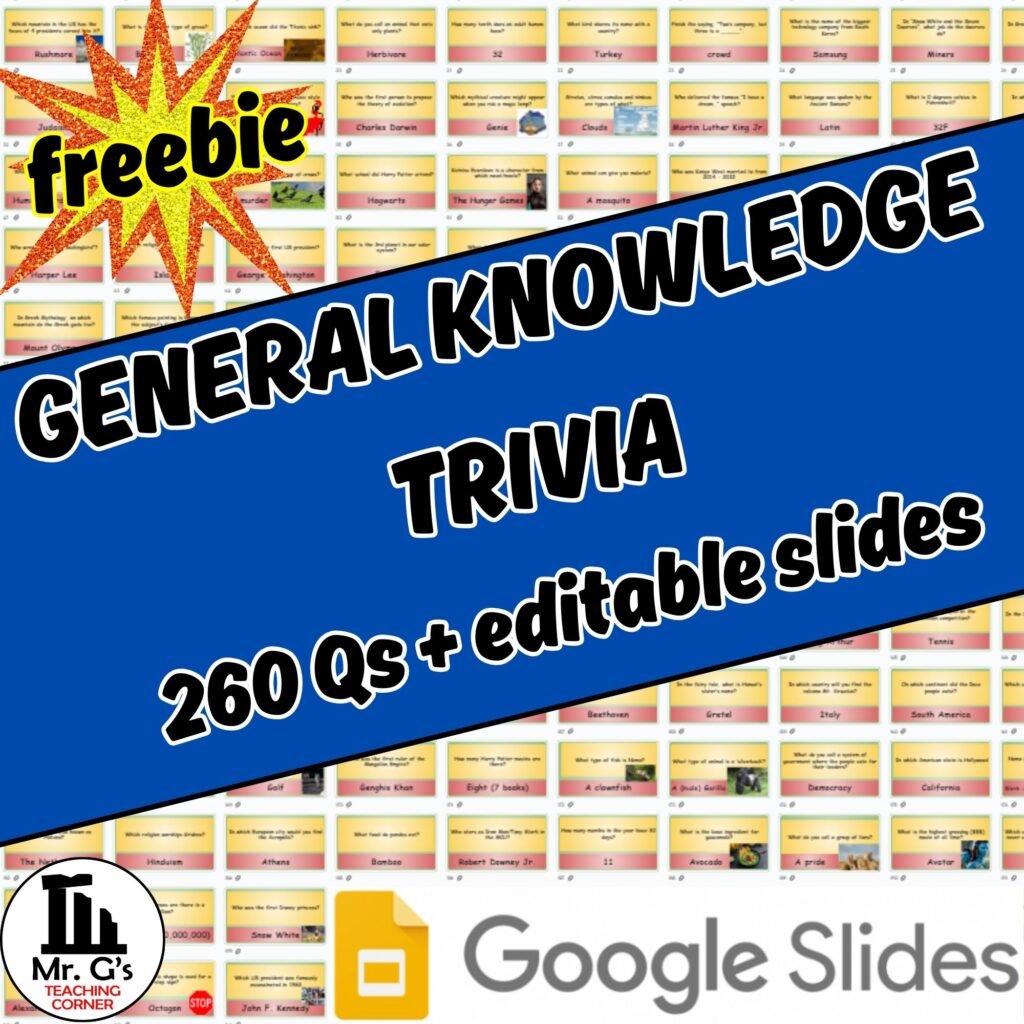
- Free trivia slide deck (available on my Free Resources page). These slides are editable, so you can add/remove any trivia questions you want.
Preparation:
Install the “Randomize Slides by Alice Keeler” add-on in Google Slides. Use this to shuffle the order each time for replayability.
How to Play:
- Split the class into two teams and line these up facing the screen at the front of the room.
- The front two students face off for a trivia question.
- Ask student A the question on the first slide, and give them 5 seconds to answer (you count down showing your fingers: 5, 4, 3, 2, 1, then, “Time’s up!”).
- Then repeat with student B.
- If one is correct and the other incorrect, the correct player gets a point.
- If both correct/incorrect, play a second round. If there’s still no winner, then it’s a tie between those players. Move on to the next.
- Continue until each player in each team has had a turn.
- The team with the most points wins.
Why I Like It:
Unlike the other games on this list, this one does not require any reviewing, so I keep it for the last quarter when students have less energy for reviewing lists. It’s quick, competitive, and fun.
Final Thoughts
These warm-up activities are fun for students and for me. They add something light and exciting to the start of class, take very little prep, and all have some learning value. If you want to try any of these in your own classroom, you can grab the ready-to-use resources from my Free Resources page.
If you adapt them or create your own variations, I’d love to hear how they go. Leave a comment, send me a message, or tag me online.
Happy teaching,
Mr. G
Its very good! I love your class Mr.G!!!!!
Comments are closed.